A Man and an Ostrich
This starts like a fable, and there might even be some moral hidden…
There is a wonderfully simple way to think about a walking horse: the front half walks roughly like a human, while the hind half walks like an ostrich.
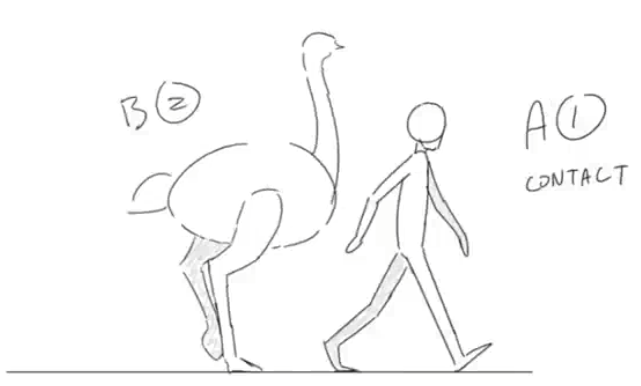
I first encountered the idea in the YouTube video That One Weird Trick to Animating Horse Walks by Dong Chang, which demonstrates it very clearly.
The video points the idea is older, by an animator Abe Levitow, and Richard Williams records his question in The Animator’s Survival Kit: “Does a horse walk like an ostrich and a man?” The Swiss Bay Levitow was an animator and director who worked at Warner Bros., UPA and MGM, including many years in Chuck Jones’s unit. Abe Levitow
This observation was especially attractive to me because Bayaya already had a procedural locomotor for humans, and parts of the same system were also used for poultry. A horse suddenly looked less like a completely new animation problem and more like two existing locomotors joined together.
So I tried exactly that.
Two locomotors make a horse
I added procedural walking to our existing animal simulation. The front and rear pairs are controlled separately, with different leg geometry and a phase offset between them, but they share the same basic locomotion machinery.
The first version worked surprisingly quickly. The horse could follow the player, turn and adapt its steps to the terrain.
But: The hooves behaved too much like human feet, the legs stayed too bent, the body motion was unnatural, and sharp turns could produce very strange poses. I kept testing the result in the game, pointing out visible problems, and letting Codex modify the implementation.
That got the system much further, but there was a limit on how far you can push a procedural system. It needed a better description of what an actual horse walk should look like.
Getting a real walk into the computer
I had eight reference drawings covering half of a horse walking cycle. They looked ideal for extracting the poses. I already attempted to trace keyframes from them manually before, and failed miserably, therefore I wanted to try a different approach now. First try was: give the images to Codex and ask it to identify the legs, joints and hooves.
It failed rather badly. When processing several frames at once, it confused limbs and placed joints far outside the corresponding parts of the drawing.
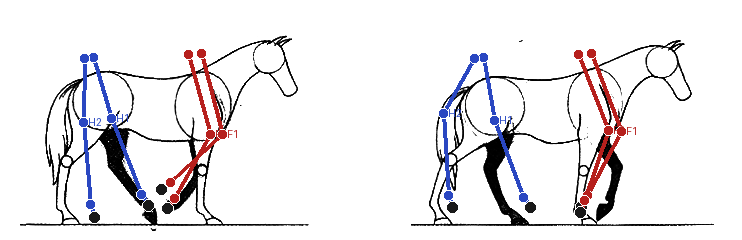
I reduced the problem to a single frame and explicitly explained that the far legs were black, the near legs light, and that the large upper joints and hooves were clearly visible. The results improved, but remained wrong.
We tried another approach: first trace the visible shapes of the legs, then derive the skeleton from them. This produced much more convincing overlays, but still not reliable geometry. A contour could suddenly follow the wrong leg, disappear where a dark leg met the body, or continue into an unrelated part of the drawing.
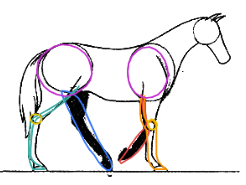
Worse, explaining a mistake in text did not necessarily make the next attempt correct.
Using AI to build the tool instead
At that point I stopped asking AI to solve the image-analysis problem directly, instead, I used it to build a small semi-automatic analysis tool.
The tool worked directly over the original raster images. It helped detect the characteristic joint shapes and leg contours, kept the four limbs separate, and let me correct ambiguous points manually. Rather than repeatedly describing that a particular joint was five pixels too far to the left, I could simply move it.
This changed the task completely.
The model no longer needed to understand the entire horse correctly in one pass. The software handled the mechanical parts, while I resolved the places where the drawing was ambiguous or partially occluded. Once one frame was understood, the same structure could be carried through the remaining images.
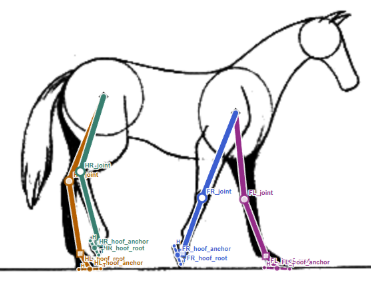
I corrected all eight poses this way and exported them as structured vector data. The eight drawings represent half of the gait cycle; our animation system already reconstructs the other half by mirroring, just as it does for human walking.
The resulting poses could finally serve as a reliable reference for the procedural locomotor.
Reference, not playback
The goal was never simply to play back a fixed horse animation. That is something I already did long ago when shooting a trailer. The goal is to use the reference animation as a basic for an interactive controllable horse, where each hoof stays where it land, with no sliding.
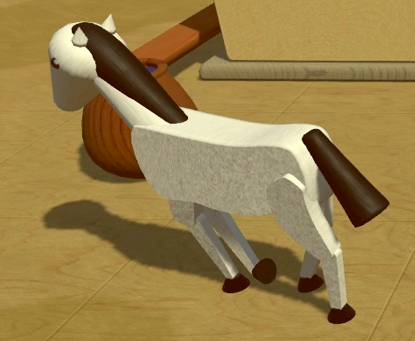
The reference cycle tells the locomotor what a convincing horse pose should look like at each stage of a step. The locomotor is still free to decide where the hooves actually land, turn the horse, react to slopes and adjust the pose to the terrain. That combination worked much better than either approach alone: a procedural system provides adaptability, while the extracted reference preserves the characteristic shape of a horse walk.
And then there is gallop
Walking turned out to fit the “man plus ostrich” model remarkably well.
Gallop is a different problem. I am currently experimenting with two approaches. One extends the procedural locomotor and tries to reproduce the timing and shape of a reference gallop. The other relies much more directly on reference poses while still connecting them to the locomotion and IK systems. I do not yet know which approach will survive.
That makes the horse a useful example of how I have been using AI during development. Directly asking a model to extract the animation looked like the shortest route, but produced errors that were difficult to correct. Using the same AI to build a purpose-specific tool took a little longer, but turned the problem into something measurable, editable and repeatable.
And underneath all of it is still Abe Levitow’s surprisingly useful question:
Does a horse walk like an ostrich and a man?
For walking, at least, the answer seems to be: almost.
Disclaimer: the man and ostrich image and animation are taken from the video by Dong Chang. Thanks for inspiration.